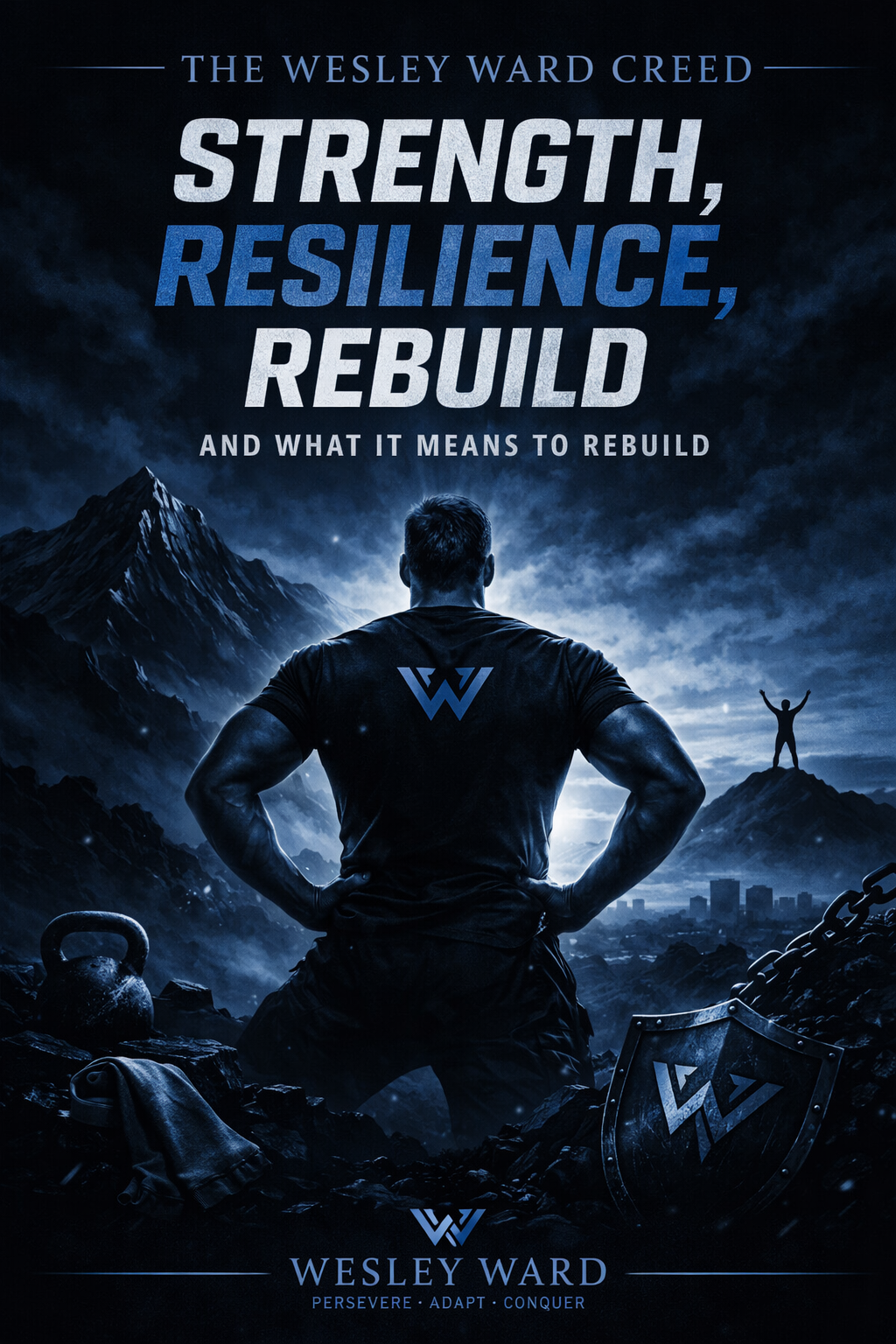
The Wesley Ward Creed: Strength, Resilience, and What It Means to Rebuild
There comes a moment in a man’s life when something shifts.
It doesn’t always arrive with warning.
Sometimes it follows a diagnosis.
A surgery.
An injury.
Or simply the quiet realization that the body no longer responds the way it once did.
Strength feels different.
Recovery takes longer.
Control becomes something you think about, not something you assume.
For many men, this moment is deeply personal.
And often, completely silent.
Because men are taught to push through.
To handle it.
To figure it out without making it visible.
But beneath that silence is a truth that deserves to be spoken clearly:
Strength is not lost in these moments.
It is redefined by them.
This is the foundation of The Wesley Ward Creed.
The Creed Begins Where Comfort Ends
Every man prefers the version of himself that feels effortless.
The body that performs without resistance.
The strength that comes without question.
The confidence that doesn’t need to be rebuilt.
But life doesn’t operate on comfort.
At some point, every man is forced into a situation where adaptation is required.
And in that moment, there are only two paths forward.
To retreat. Or to rebuild.
The Creed begins at that exact point of decision.
Resilience Is Not Passive
Resilience is often misunderstood.
It is not quiet endurance.
It is not pretending nothing has changed.
Resilience is active.
It is the decision to face reality directly and respond with intention.
For the man recovering from prostate surgery, resilience means doing the work required to regain control.
For the athlete experiencing unexpected setbacks, it means adjusting training, not abandoning it.
For the man navigating changes in his body, it means learning, adapting, and moving forward.
Resilience is not about returning to who you were.
It is about becoming someone stronger because of what you’ve faced.
Grit Is Built in the Unseen Moments
The most defining work a man does is rarely visible.
It happens early in the morning.
Late at night.
In quiet routines no one else sees.
Rehabilitation exercises.
Adjusted workouts.
Small daily efforts to regain strength, coordination, and control.
This is where grit is built.
Not in dramatic moments.
But in consistency.
In showing up again and again, even when progress feels slow.
Even when the outcome is uncertain.
Because grit is not about intensity.
It is about persistence.
The Modern Definition of Strength
For generations, strength has been defined by outward performance.
How much a man can lift.
How fast he can run.
How long he can endure.
But real strength goes deeper.
It is the ability to adapt when circumstances change.
To maintain identity when the body evolves.
To move forward without losing confidence.
A man rebuilding after surgery is strong.
A man confronting physical limitations is strong.
A man who refuses to let setbacks define him is strong.
Strength is not the absence of challenge. It is the response to it.
Control Is Earned, Not Assumed
One of the most overlooked aspects of recovery is control.
Control over movement.
Control over the body.
Control over confidence.
When that control is disrupted, even slightly, it can affect how a man carries himself.
How he trains.
How he moves through the world.
How he sees himself.
But control is not something permanently lost.
It is something that can be rebuilt.
Through training.
Through awareness.
Through the right support systems.
And when control is regained, it often comes back stronger - because it has been earned, not assumed.
The Man Who Rebuilds
There is a distinct difference between a man who avoids setbacks and a man who rebuilds through them.
The man who rebuilds understands something others do not.
That the body is not fixed.
It is adaptable.
That strength is not static.
It evolves.
That identity is not tied to perfection.
It is defined by action.
This man does not retreat from change.
He engages with it.
He studies it.
He trains through it.
He refines himself because of it.
He becomes more disciplined.
More aware.
More resilient.
This is the man the Wesley Ward Creed is built for.
Recovery Is Not the End
Too often, recovery is viewed as a return.
A return to baseline.
A return to normal.
A return to what once was.
But that perspective is limited.
True recovery is not a step backward.
It is a step forward into a more refined version of strength.
A man who has rebuilt understands his body differently.
He trains with more intention.
Moves with more awareness.
Operates with more discipline.
He is not simply recovered.
He is evolved.
The Creed in Practice
The Wesley Ward Creed is not theoretical.
It is lived.
It shows up in:
• choosing movement when it would be easier to stop
• training the overlooked systems of the body
• refusing to accept limitations without challenge
• investing in solutions that support performance and recovery
• carrying yourself with confidence, regardless of circumstance
It is a mindset.
And like any mindset, it is strengthened through action.
What It Means to Be a Man
The definition of masculinity is shifting.
It is no longer about ignoring reality.
It is about confronting it.
It is no longer about hiding struggle.
It is about transforming through it.
It is no longer about control without effort.
It is about control earned through discipline.
To be a man is not to be unaffected by life.
It is to respond to it with strength.
To adapt.
To rebuild.
To continue forward.
Forward. Always.
At its core, the Wesley Ward Creed is simple.
Life will challenge the body.
That is inevitable.
But what comes next is a choice.
To slow down.
Or to rebuild.
To accept limitations.
Or to redefine them.
To retreat.
Or to move forward.
Always.